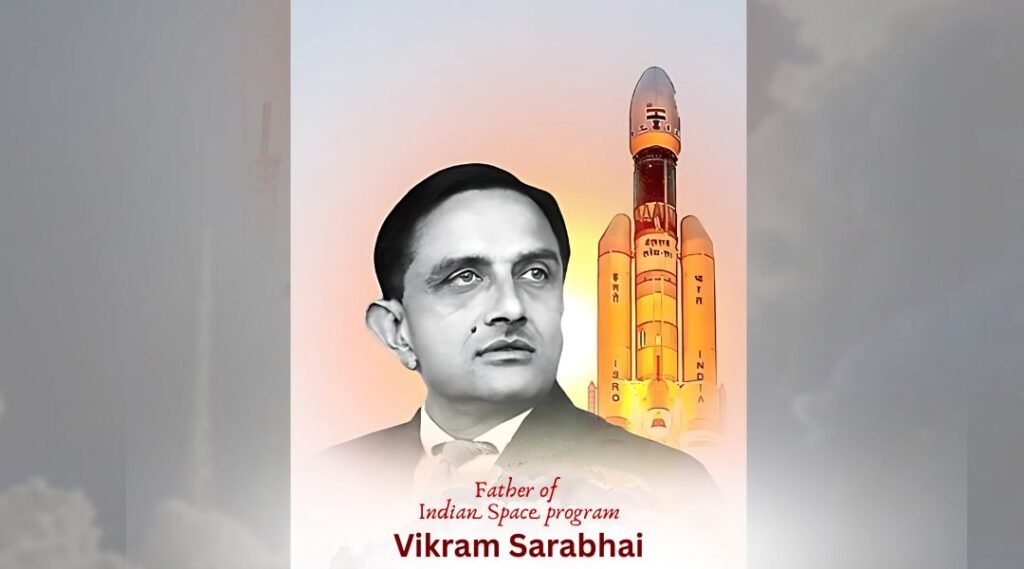
Dr. Vikram Sarabhai, often hailed as the Father of the Indian Space Program, was a visionary scientist, industrialist, and innovator whose contributions laid the foundation for India’s progress in science and technology. Born on August 12, 1919, in Ahmedabad, Gujarat, Dr. Sarabhai was instrumental in transforming India from a developing nation into a space-faring country.
Early Life and Education
Dr. Sarabhai came from an affluent and supportive family. He pursued his higher studies at Cambridge University, where he earned his doctorate in cosmic ray physics. His deep interest in science and the development of India inspired him to return home and work towards nation-building through scientific advancement.
Read it also: Healing Minds Through Music on World Music Day: Rishabh Sharma
Contribution to India
- Establishing ISRO: Dr. Sarabhai was the driving force behind the formation of the Indian Space Research Organisation (ISRO) in 1969. He believed that space technology could address India’s development needs in education, communication, and natural resource management.
- Satellite Development: Under his leadership, India successfully launched its first satellite, Aryabhata, in 1975 (after his death, but based on his vision). He initiated satellite communication experiments that helped reach remote villages with educational TV programs.
- Institutions and Research: Dr. Sarabhai founded several key institutions like the Physical Research Laboratory (PRL) in Ahmedabad, the Indian Institute of Management Ahmedabad (IIM-A) (along with Kasturbhai Lalbhai), and the Community Science Centre to promote scientific education and research in India.
- Promoting Nuclear Science: As chairman of the Atomic Energy Commission after Homi Bhabha’s death, Dr. Sarabhai played a crucial role in developing India’s nuclear capabilities for peaceful purposes.
Legacy
Dr. Sarabhai’s vision continues to inspire generations of Indian scientists. His belief that “we do not have the fantasy of competing with the economically advanced nations in the exploration of the moon or the planets or manned space-flight”, but rather to use space science for the betterment of the common man, still guides ISRO’s mission today.
He passed away on December 30, 1971, but his legacy lives on. In his honor, ISRO’s space research center in Thiruvananthapuram was renamed the Vikram Sarabhai Space Centre (VSSC), and India’s first lunar lander (part of Chandrayaan-2 and Chandrayaan-3) is also named Vikram.
Dr. Vikram Sarabhai was more than just a scientist — he was a nation-builder. His vision, leadership, and dedication to using science for social transformation helped India emerge as a global space power. He remains a symbol of what one individual’s dream and determination can achieve for an entire nation.